In My Own Bubble
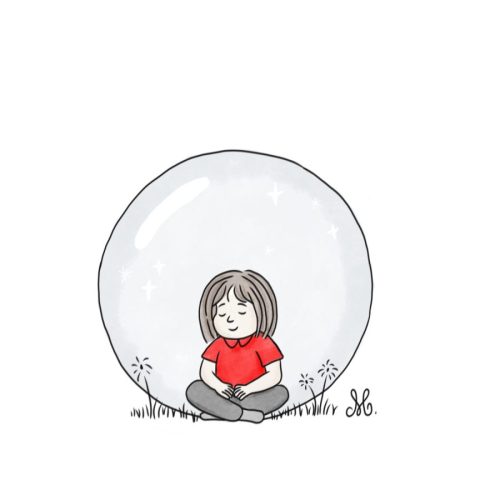
There are children who, quietly, drift into their own bubble.
An invisible bubble, yet very real. Soft, silent, and reassuring.
It is neither withdrawal nor escape — it is a space of calm where they can reconnect, breathe, and dream.
Inside this bubble, colors feel softer, sounds are muted, and emotions gently unfold.
It is a world where imagination reigns, where one feels safe, far from the noise of the outside world.
For sensitive, creative, and neurodivergent children, this bubble is a vital need — a shelter where they recharge their inner energy.
It should never be forced or interrupted.
It deserves to be respected like a sanctuary.
Respecting Their Inner World
Children who spend time in their bubble are not absent.
They are present in their own way — listening to themselves, listening to the world, but through their own unique antennas.
Their bubble is a place of transformation: emotions are sorted, ideas take shape, and wounds begin to heal.
Sometimes they emerge with a bright thought, an unexpected word, a drawing, or a silence that speaks louder than a thousand words.
These children often carry a deep inner richness, a sensitivity that perceives the invisible, an intuition that understands before knowing.
Accepting this allows them to grow without feeling “too much” or “not enough.”
Bubbles as Stepping Stones
With time, trust, and understanding, this bubble becomes an anchor point —
a personal space from which they can gradually open up to the world.
It is not a wall, but a door that opens at their own pace.
Children who need this time for themselves are often those who bring a new perspective, a deep presence, and a genuine creativity.
Let us support them with kindness, without judgment.
Let them show us that their bubble is not a refuge from life, but a gentle way of living within it.
To explore more about these unique children, visit our page dedicated to
extraordinary children.
And to follow my sensitive and poetic illustrations, join me on
Facebook.
Awakening the Senses
Sometimes, certain sounds, lights, or textures may bother you more than others.
That’s because your senses are highly sensitive — they notice more things at once.
And that’s okay! To feel better, you can find a quiet place, wear headphones, or touch soft objects that soothe you.
Learning to listen to your body and what makes you feel good is essential to living peacefully in a world that can sometimes feel too loud or overwhelming.