When Winter Inspires Children’s Imagination
The Snowman, a One-Day Companion
All it takes is a few snowflakes, a carrot nose, and two pebbles for eyes to bring a charming character to life. The snowman is an iconic figure of childhood—fleeting, yet unforgettable. It embodies those precious moments when children fully connect with the season, with play, and with their own inner world.
A Children’s Illustration That Celebrates Simplicity
This illustration explores moments of purity and quiet joy. Far from noise and rush, it lingers on gentle gestures: small gloved hands shaping snow, a knowing glance between friends or siblings, the soft silence of a snowy landscape. Its aesthetic is simple, seen from a child’s perspective.
A Drawing That Speaks to Everyone, at Their Own Pace
Some children express themselves loudly, others quietly. Some run, others observe. This drawing leaves room for every way of being. It doesn’t impose a rhythm—it invites contemplation. For more sensitive or dreamy children, it becomes a window into calm emotion, an invitation to feel without needing to explain.
The Power of Creating a Character
Building a snowman is already telling a story. It’s giving it a shape, sometimes a name, even a personality. This intuitive and creative process is a fertile ground for children who love to invent, connect, and project their ideas onto the world. Through this simple activity, they gain confidence in their ability to create meaning.
Simple Yet Deep Emotions
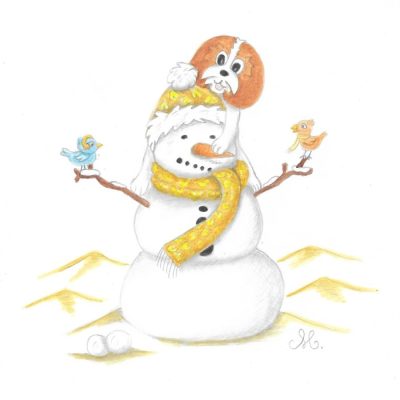
The drawing shows not only the snowman, but also what it inspires: laughter, surprise, pride—and sometimes a touch of sadness when it melts. These are rich emotions that help children grow gently through experience. A well-crafted illustration echoes these feelings with subtlety.
A Visual World Designed for Sensitivity
Marina Bassano’s universe is built on soothing atmospheres, endearing characters, and careful attention to detail. Each illustration is like a silent story that children can continue in their own way. The snowman drawing fits perfectly into this gentle and sincere approach.
Small Details That Truly Matter
An oversized scarf, a crooked hat, a slightly uneven smile—these little imperfections tell something human. They make us smile, they move us, and they create an emotional bond between the child and the image. In a world that can feel demanding, this kind of illustration offers a breath of freedom.
Winter, a Playground for Imagination
Under the snow, sounds change, shapes blur, and familiar landmarks shift. It’s a season made for invention. Children build huts, imagine secret paths, and create icy heroes. The snowman becomes one of them: a friend, a protector, a character to love—even if only for a day.
A Tool to Nurture Creativity
Offering a child an illustration like this is offering a starting point. They can imagine what the snowman does when no one is watching, give it a voice, invent its adventures. This kind of support encourages free imagination, away from constraints—a private space where children can develop their own world.
Books to Continue the Story
Marina Bassano’s visual world also lives through her children’s books—tender, often funny, sometimes deep stories where sensitive, imaginative, or dreamy children can recognize themselves. To explore Ecco’s adventures further, discover the books on Amazon.
A Drawing That Feels Good
This snowman is more than a seasonal character. It becomes a quiet witness to childhood—those precious moments when everything feels possible. Children can project themselves, laugh, dream, or simply watch the snow fall. This calm visual space brings comfort and allows everyone to reconnect with themselves.
A Visual Language Beyond Words
It’s not always easy to put feelings into words. That’s why illustrations hold such power. They show without imposing. They suggest, open, and accompany. And sometimes, that’s all a child needs: an image that understands without asking questions.
Conclusion
This snowman illustration is more than a winter theme—it’s a way of telling childhood differently. With poetry, slowness, and tenderness. Such drawings become a subtle yet powerful tool to nurture children in who they are, what they feel, and what they create. And that makes all the difference.